
Economy

By Keshav Sharma , 12 May 2026

India’s automobile industry has fallen significantly short of its mandated vehicle scrappage obligations under the Environment Protection (End-of-Life Vehicle) Rules, 2025, achieving only around 30 percent of the required steel-equivalent recycling target during FY26. The regulations, introduced by the Ministry of Environment, Forest and Climate Change and implemented from April 1, 2025, were designed to strengthen sustainable mobility practices and formalize the vehicle recycling ecosystem.

By Vibha Dhawan , 12 May 2026

India’s equity markets witnessed a turbulent trading week as the combined market capitalization of four of the country’s 10 most valuable companies declined by nearly Rs 1 lakh crore, reflecting persistent investor caution amid global geopolitical uncertainty. State Bank of India recorded the steepest erosion in valuation as markets struggled to maintain momentum despite modest gains in benchmark indices.

By Vibha Dhawan , 10 May 2026

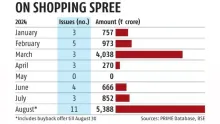
India’s capital markets regulator has proposed sweeping reforms to the corporate share buyback framework in a move aimed at improving transparency, efficiency, and investor confidence. The Securities and Exchange Board of India (Sebi) has suggested reintroducing open market buybacks through stock exchanges while significantly reducing execution timelines from six months to 66 working days. The proposals indicate a broader regulatory push toward faster capital redistribution and stronger market discipline.

By Vibha Dhawan , 9 May 2026

India’s electric passenger vehicle segment recorded robust growth in April 2026, with sales rising 75.14 percent year-on-year to 23,506 units, according to the Federation of Automobile Dealers Associations. The surge underscores accelerating adoption of electric mobility, supported by favorable policy frameworks and increasing consumer acceptance. Tata Motors Passenger Vehicles Ltd retained its leadership position, posting sales of 8,543 units, up 77.17 percent from the previous year.

By Keshav Sharma , 7 May 2026

The price of Aviation Turbine Fuel (ATF), a critical cost component for airlines, has risen for international carriers by over 5 percent, reflecting the continued impact of global energy market volatility. According to state-owned oil companies, ATF in Delhi has increased to Rs. 1,511.86 per kilolitre (converted from USD), marking the second consecutive monthly hike. Notably, domestic airline fuel prices remain unchanged, indicating a calibrated pricing approach.

By Harish Thapar , 4 May 2026

India’s automobile industry is confronting a potential Rs. 25,000 crore impact on profitability in FY26 following the implementation of the Environment Protection (End-of-Life Vehicles) Rules 2025. A key provision mandates automakers to account for environmental obligations tied to vehicles already sold, triggering accounting requirements under Extended Producer Responsibility (EPR). Industry executives report that auditors have flagged the clause’s significant financial implications, prompting companies to reassess provisioning strategies.

By Harish Thapar , 27 April 2026

Gold and silver prices are expected to face selling pressure in the coming holiday-shortened trading week as global investors closely monitor geopolitical developments and macroeconomic signals. Market participants are tracking ongoing diplomatic engagement between the United States and Iran, movements in crude oil prices and the upcoming policy decision by the US Federal Reserve. These factors are likely to influence investor sentiment and safe-haven demand for precious metals.

By Keshav Sharma , 27 April 2026

India’s residential real estate market is witnessing a structural shift, with affordable housing sales declining sharply in early 2026 even as premium segments continue to gain traction. Data indicates a 23 percent year-on-year drop in homes priced below Rs 50 lakh across major urban centers, driven largely by constrained supply and rising input costs. Mid-income housing has also softened, signaling broader demand recalibration. 

By Vibha Dhawan , 27 April 2026

Artificial intelligence is rapidly reshaping India’s employment landscape, with growing evidence suggesting that AI proficiency will soon become a decisive factor in salary growth. Industry estimates indicate that a vast majority of knowledge workers are already leveraging AI tools, while employers increasingly prioritize these capabilities in hiring decisions. Over the next two to three years, sectors such as technology, global capability centers (GCCs), and banking, financial services, and insurance (BFSI) are expected to witness accelerated compensation shifts.

By Keshav Sharma , 20 April 2026

India and South Korea have initiated fresh discussions to modernize their existing Comprehensive Economic Partnership Agreement (CEPA), aiming to unlock new avenues of bilateral trade and investment. The dialogue, led by senior trade officials from both countries, reflects a strategic effort to deepen economic integration across sectors such as manufacturing, green energy, and digital trade. As global supply chains undergo realignment, both nations are seeking to enhance market access, streamline trade barriers, and promote industrial collaboration.