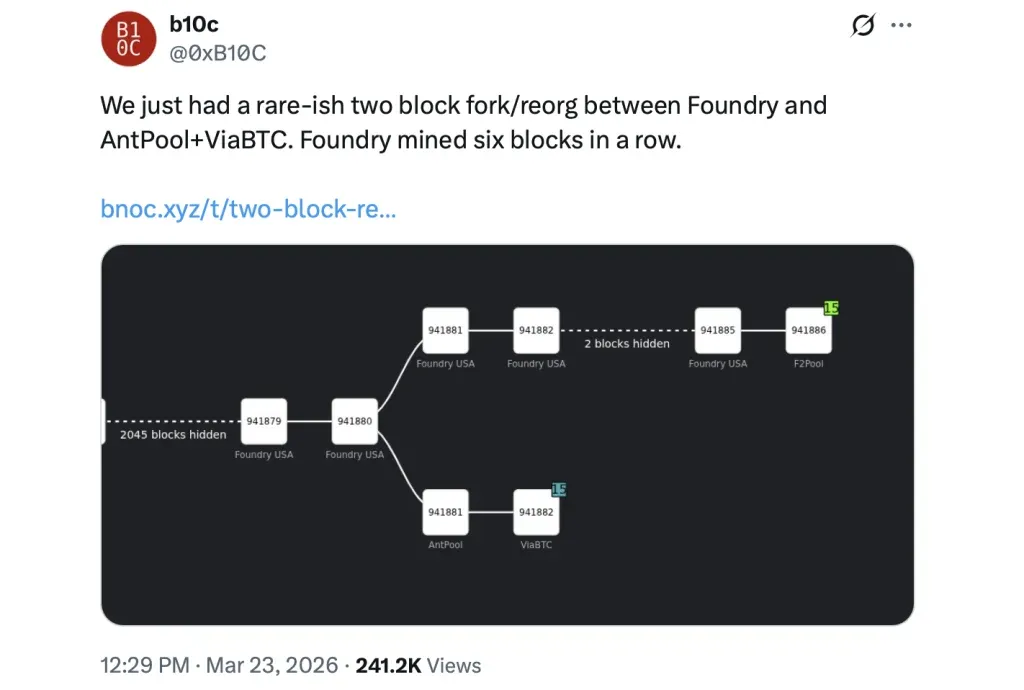
A rare two-block reorganization in the Bitcoin network briefly disrupted block sequencing but ultimately demonstrated the resilience of its decentralized architecture. The incident, triggered by near-simultaneous block creation by competing mining pools, led to a temporary fork before consensus was restored. Despite concerns, no user funds were affected, and the network continued operating smoothly. The event underscores the competitive dynamics among mining pools and the robustness of blockchain consensus mechanisms. For investors and analysts, it offers a timely reminder that even unusual technical anomalies do not necessarily compromise the integrity or long-term viability of major cryptocurrencies.
Understanding the Two-Block Reorganization Event
The Bitcoin network experienced an uncommon technical event known as a two-block reorganization, or “reorg,” when two competing versions of the blockchain briefly coexisted. This occurred as multiple mining pools produced valid blocks at nearly the same time, creating a temporary divergence in the chain.
Such incidents are rare but not unprecedented in proof-of-work systems. In this case, the fork lasted only a short duration before the network resolved it by selecting the longer chain, in accordance with consensus rules. Importantly, the reorganization did not disrupt transactions or compromise user assets.
Role of Mining Pools and Competitive Dynamics
The reorg highlighted the growing concentration and competition among large mining pools, particularly entities like Foundry USA and AntPool. These pools operate vast computational resources, enabling them to influence block production rates.
During the event, one pool extended its chain more rapidly, ultimately becoming the accepted version of the blockchain. This outcome reflects the fundamental principle of longest-chain consensus, where computational power and speed determine temporary dominance.
While competition among miners is integral to network security, such events also reveal the increasing centralization pressures within mining ecosystems—an issue that continues to attract scrutiny from blockchain purists and institutional stakeholders alike.
Technical Implications for Blockchain Integrity
From a technical standpoint, a two-block reorganization is considered a low-severity anomaly. Blockchain protocols are specifically designed to accommodate such occurrences without undermining overall system stability.
The network’s ability to resolve the fork autonomously demonstrates the effectiveness of its consensus algorithm. Transactions included in orphaned blocks are typically reprocessed, ensuring that no legitimate activity is permanently lost.
For developers and infrastructure providers, the event serves as a validation of system robustness rather than a cause for alarm. It also reinforces the importance of continuous monitoring and network transparency.
Market and Investor Perspective
Despite the unusual nature of the reorg, market sentiment remained largely unaffected. Investors in Bitcoin are increasingly accustomed to technical fluctuations that do not materially impact economic fundamentals.
The absence of financial loss or prolonged disruption prevented any significant volatility in price or trading volumes. This resilience reflects a maturing market where participants differentiate between structural risks and routine technical events.
Moreover, institutional investors continue to view such incidents through a long-term lens, focusing on network security, adoption trends, and macroeconomic factors rather than isolated anomalies.
Broader Significance for the Crypto Ecosystem
The episode underscores a broader narrative within the cryptocurrency industry: the balance between decentralization and operational efficiency. As mining power consolidates among fewer large players, the probability of such competitive overlaps may increase.
However, the swift resolution also reinforces confidence in blockchain’s self-correcting mechanisms. It highlights how decentralized systems can maintain integrity even under conditions of temporary disagreement.
For policymakers, technologists, and investors, the event offers a nuanced perspective—demonstrating that while the system is not immune to irregularities, it is inherently designed to withstand and adapt to them.
Conclusion
The recent two-block reorganization in the Bitcoin network serves as a case study in resilience rather than vulnerability. While the event momentarily exposed the competitive intensity among mining pools, it ultimately reaffirmed the strength of decentralized consensus.
As the cryptocurrency market evolves, such technical episodes will likely continue to occur. However, their impact is expected to remain limited, provided the underlying architecture continues to function as intended. For stakeholders across the financial spectrum, the takeaway is clear: stability in blockchain systems is defined not by the absence of anomalies, but by the efficiency with which they are resolved.
Comments