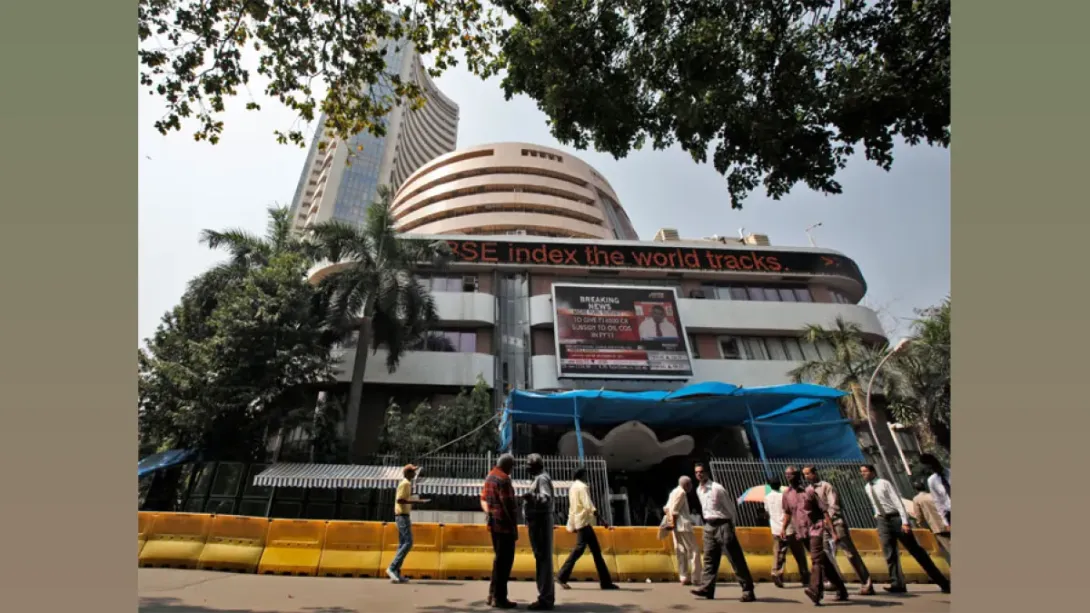
India’s benchmark equity indices rebounded strongly on Monday after three consecutive sessions of sharp declines, driven by renewed investor interest in blue-chip banking stocks. The BSE Sensex climbed 938.93 points, or 1.26 percent, to close at 75,502.85, while the NSE Nifty rose 257.70 points, or 1.11 percent, ending the day at 23,408.80. Market participants engaged in value-buying after the recent correction, particularly in large-cap companies.
Shares of UltraTech Cement led the rally, while several financial and industrial stocks also posted notable gains. The recovery reflects investor confidence in India’s long-term economic outlook despite short-term market volatility.
Market Recovery After Three-Day Decline
Indian equity markets staged a strong rebound on Monday after experiencing significant losses in the previous three trading sessions.
The BSE Sensex surged 938.93 points, representing a gain of 1.26 percent, to close at 75,502.85. During intraday trading, the index touched a high of 75,805.27 and a low of 73,949.76.
Meanwhile, the NSE Nifty advanced 257.70 points, or 1.11 percent, finishing the day at 23,408.80.
Banking Stocks Lead the Rally
The market recovery was largely driven by value-buying in blue-chip banking and financial stocks. Investors took advantage of lower valuations following the recent market correction.
Financial stocks often act as market leaders during recovery phases due to their close relationship with economic growth and credit expansion.
Top Gainers
Among the 30 companies listed on the Sensex, several major firms posted strong gains. UltraTech Cement led the rally with a rise of 4.22 percent.
Other notable gainers included Trent, HDFC Bank, Mahindra & Mahindra, Eternal, Bajaj Finance, ITC, Tata Steel, and State Bank of India.
Market Outlook
Market strategists suggest that the rebound reflects a healthy correction rather than a structural shift in market sentiment.
India’s equity markets continue to attract long-term investors due to strong economic fundamentals, improving corporate earnings, and sustained domestic liquidity.
Comments