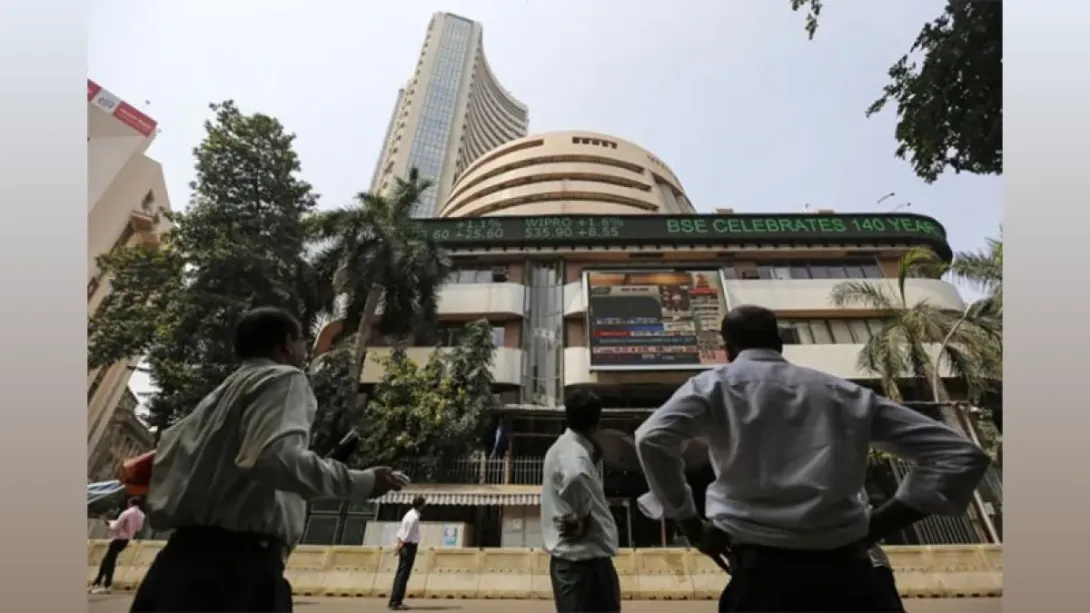
Indian equity benchmarks closed lower on Thursday after a volatile trading session marked by persistent foreign institutional investor outflows and rising geopolitical uncertainty. The BSE Sensex declined 114 points to settle at 77,844.52, while the NIFTY 50 ended marginally lower at 24,326.65. Markets swung sharply during intra-day trade as investors reacted cautiously to global risk factors, fluctuating sentiment, and concerns surrounding capital flows. Analysts said the subdued close reflected broader investor nervousness despite underlying resilience in domestic economic fundamentals, with volatility expected to persist amid uncertainty in global financial and geopolitical conditions.
Indian Markets End Lower After Volatile Trading Session
Indian benchmark equity indices closed in negative territory on Thursday following a highly volatile trading session driven by investor caution and external market pressures.
The 30-share BSE Sensex declined 114 points, or 0.15 percent, to settle at 77,844.52 after witnessing sharp fluctuations throughout the day. The index moved within a broad intra-day range of 671.49 points, touching a high of 78,384.70 and slipping to a low of 77,713.21 before ending lower.
Meanwhile, the 50-share NSE Nifty closed marginally lower by 4.30 points, or 0.02 percent, at 24,326.65.
The muted performance reflected an uncertain market environment where investors struggled to balance domestic economic optimism against growing global risks and continued foreign capital withdrawals.
Foreign Fund Outflows Continue to Pressure Sentiment
One of the primary factors influencing Thursday’s market movement was sustained foreign institutional investor selling.
Foreign portfolio flows remain a critical driver of liquidity and sentiment in emerging markets such as India. Persistent outflows often create downward pressure on benchmark indices, particularly during periods of elevated global uncertainty.
Market analysts noted that international investors continue to adopt a cautious stance amid concerns surrounding global interest rate trajectories, currency volatility, and geopolitical tensions affecting broader financial markets.
While domestic institutional investors have provided some stability through continued participation, the scale of foreign fund withdrawals has contributed to heightened market volatility in recent sessions.
Experts believe investor behavior is currently being shaped by a combination of risk aversion and portfolio rebalancing across global asset classes.
Geopolitical Uncertainty Adds to Market Volatility
Geopolitical developments also played a major role in influencing market sentiment during the trading session.
Global financial markets remain sensitive to geopolitical instability because such events often affect commodity prices, currency movements, trade expectations, and broader investor confidence.
In particular, concerns surrounding international conflicts and diplomatic tensions have increased caution among institutional investors, leading to more defensive positioning in equity markets.
Indian markets, despite relatively strong domestic fundamentals, remain interconnected with global capital flows and international risk sentiment. As a result, external geopolitical developments frequently influence short-term trading behavior even when domestic economic indicators remain stable.
Analysts expect volatility to persist as investors continue monitoring geopolitical signals alongside central bank policy developments and global growth expectations.
Market Swings Reflect Fragile Investor Confidence
The wide intra-day movement in the Sensex highlighted the fragile state of investor confidence.
Sharp swings during the session suggested that traders were reacting rapidly to both global cues and evolving market sentiment. Such volatility is increasingly common during periods when investors face uncertainty regarding macroeconomic direction and financial market stability.
Despite the negative close, analysts observed that markets continued to demonstrate underlying resilience, with declines remaining relatively contained compared to the intensity of intra-day fluctuations.
This indicates that while caution dominates near-term sentiment, long-term confidence in India’s economic growth story has not significantly weakened.
Domestic consumption trends, infrastructure investment, and corporate earnings expectations continue to provide support to broader market valuations.
Defensive Sectors Attract Investor Attention
In volatile market environments, investors typically rotate toward defensive sectors perceived as more stable during uncertain economic conditions.
Financial experts noted increased interest in sectors such as pharmaceuticals, utilities, and consumer staples, which are generally considered less vulnerable to short-term economic disruptions.
Meanwhile, rate-sensitive and globally exposed sectors experienced mixed performance due to uncertainty surrounding external demand conditions and capital flows.
Technology and export-oriented stocks also remained sensitive to currency fluctuations and global growth concerns during the session.
Sectoral divergence has become more pronounced in recent weeks as investors selectively reposition portfolios based on evolving macroeconomic risks.
Domestic Economic Fundamentals Remain Supportive
Despite recent market volatility, analysts continue to emphasize the strength of India’s underlying economic fundamentals.
India remains one of the fastest-growing major economies globally, supported by strong domestic consumption, public infrastructure spending, manufacturing expansion, and improving private investment activity.
Corporate earnings across several sectors have also remained relatively healthy compared with many global peers.
However, market experts caution that strong economic fundamentals alone may not shield equities entirely from short-term global financial disruptions, particularly when foreign portfolio flows become volatile.
The interaction between domestic growth optimism and external uncertainty is likely to remain a defining feature of Indian markets in the near term.
Central Bank Policy Expectations Under Watch
Investors are also closely monitoring global and domestic monetary policy developments.
Interest rate expectations continue to influence capital allocation decisions worldwide, particularly in emerging markets. Any signals regarding future central bank actions can significantly affect equity valuations, bond yields, and currency movements.
Market participants remain attentive to inflation trends, liquidity conditions, and policy commentary from major central banks as they assess future risk appetite.
In India, investors are simultaneously evaluating how domestic monetary policy may evolve amid stable growth conditions and global financial uncertainty.
Such factors are expected to remain central to market direction over the coming weeks.
Volatility Likely to Persist in Near Term
Thursday’s market performance reinforced the view that volatility may continue dominating trading activity in the short term.
Persistent foreign fund outflows, geopolitical risks, and global macroeconomic uncertainty are likely to keep investor sentiment cautious despite supportive domestic indicators.
At the same time, India’s long-term economic outlook continues to attract institutional interest, particularly among investors seeking exposure to structural growth opportunities in emerging markets.
Financial strategists believe markets may remain range-bound in the near term, with sharp intra-day swings reflecting changing global cues and investor positioning.
For now, Thursday’s choppy session highlighted a market environment where optimism regarding India’s economic resilience is increasingly being tested by broader global uncertainty.
Comments