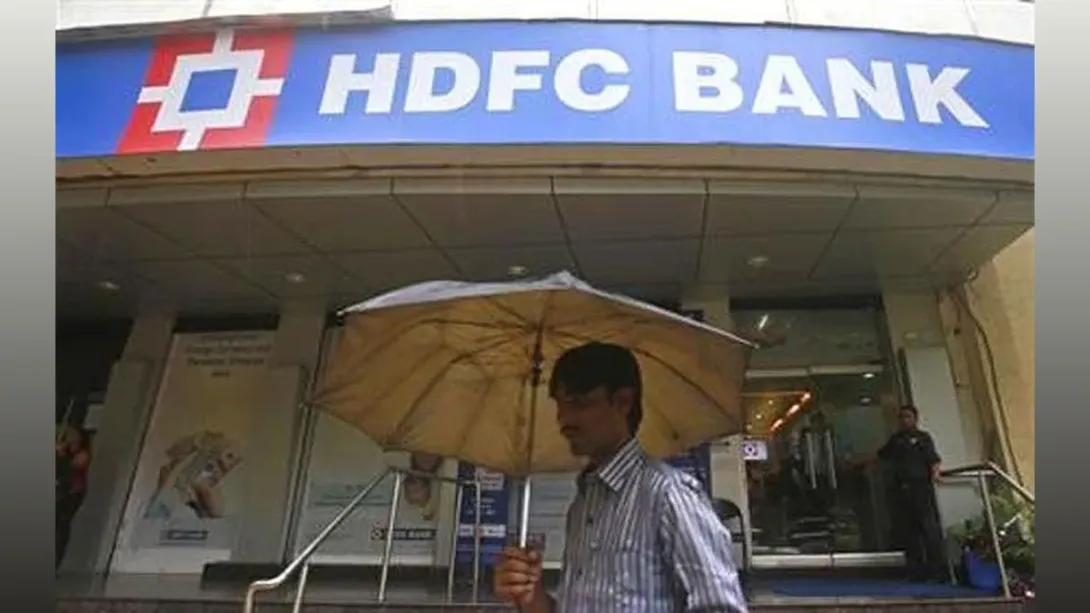
HDFC Bank witnessed a sharp decline in its share price following the sudden resignation of its chairman, Atanu Chakraborty, who stepped down citing ethical concerns. The development unsettled investor sentiment, leading to a steep erosion in market capitalization and dragging benchmark indices lower. The stock fell to its 52-week low, reflecting heightened uncertainty around governance and leadership continuity. As one of India’s largest financial institutions, the bank’s performance holds significant weight in the broader market, making the episode a critical moment for stakeholders and raising questions about corporate governance standards.
Leadership Exit Sparks Market Reaction
Shares of HDFC Bank came under intense selling pressure after the abrupt resignation of Chairman Atanu Chakraborty. The exit, attributed to concerns over internal ethical issues, triggered a wave of caution among investors, resulting in a sharp intraday decline.
On the Bombay Stock Exchange (BSE), the stock dropped 8.41 percent to Rs. 772, marking its 52-week low. A similar trend was observed on the National Stock Exchange (NSE), where the shares fell 8.66 percent to Rs. 770. The magnitude of the fall underscores the sensitivity of financial markets to leadership changes, particularly in systemically important institutions.
Significant Erosion in Market Capitalization
The sell-off led to a substantial decline in the bank’s market valuation. HDFC Bank saw its market capitalization shrink by approximately Rs. 65,176.48 crore, bringing the total valuation down to Rs. 12,31,666.45 crore.
Such a sharp erosion in investor wealth highlights the broader implications of governance-related developments. In the banking sector, where trust and transparency are fundamental, even perceived uncertainties can translate into immediate financial repercussions.
Impact on Broader Market Indices
The decline in HDFC Bank shares also weighed heavily on benchmark indices. The 30-share BSE Sensex fell by 1,740.34 points to 74,949.92 during morning trade, while the NSE Nifty declined by 514.85 points to 23,262.95.
Given the bank’s significant weightage in major indices, its sharp fall contributed to broader market weakness. This illustrates how developments within a single large-cap entity can influence overall market direction.
Governance Concerns and Investor Sentiment
The resignation, reportedly linked to ethical considerations, has raised questions regarding internal governance practices. While specific details remain limited, the absence of clarity has amplified investor anxiety.
In financial markets, leadership credibility and governance frameworks play a crucial role in sustaining long-term investor confidence. Any disruption in these areas often leads to heightened scrutiny from regulators, analysts, and institutional investors.
Outlook and Strategic Implications
Despite the immediate negative reaction, the long-term impact on HDFC Bank will depend on how swiftly and transparently the institution addresses concerns. The appointment of interim leadership and clear communication strategies will be critical in restoring market confidence.
From a broader perspective, the episode serves as a reminder of the importance of robust governance structures in large financial institutions. Investors are likely to closely monitor subsequent developments, including leadership transitions and internal reviews.
Conclusion
The sharp decline in HDFC Bank shares following the chairman’s resignation underscores the market’s acute sensitivity to governance-related developments. With significant value erosion and broader market impact, the incident highlights the critical role of leadership stability in maintaining investor trust.
As the bank navigates this period of uncertainty, its response will be pivotal in determining whether confidence can be restored and long-term growth prospects remain intact.
Comments