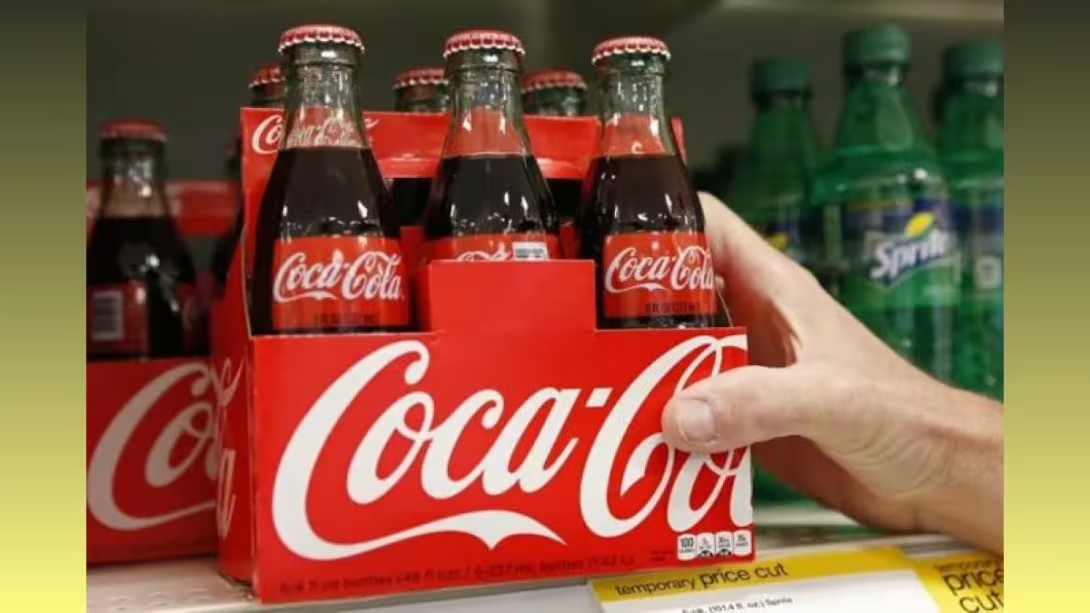
The Coca-Cola Company is laying the groundwork for what could become one of the most closely watched consumer-sector public offerings in India. The global beverage leader has confirmed that it is evaluating a stock market debut for Hindustan Coca-Cola Holdings Pvt. Ltd. (HCCH), the holding company that oversees its largest Indian bottling operations, with a potential listing targeted for 2027.
According to company disclosures, preliminary preparations have already begun for a possible listing on India's two principal stock exchanges—the Bombay Stock Exchange (BSE) and the National Stock Exchange (NSE). The proposal remains contingent upon market conditions, regulatory approvals, and other customary requirements.
Strategic Shift in India
The contemplated IPO signals a significant strategic development in Coca-Cola’s long-term approach to India, one of the world's fastest-growing consumer markets. Beyond raising capital, a public listing would provide greater visibility into the financial performance of the company's bottling operations while creating opportunities for broader investor participation.
The company is simultaneously assessing the possibility of reducing a portion of its ownership stake in HCCH as part of the listing process. Such a move would allow Coca-Cola to unlock value from its Indian operations while maintaining a meaningful presence in a market considered central to its future growth ambitions.
Building on Recent Ownership Changes
The latest development follows a major transaction completed roughly a year ago, when Coca-Cola sold a 40 percent stake in HCCH to the Jubilant Bhartia Group. Although the financial terms of that deal were not publicly disclosed, the transaction was widely viewed as a strategic partnership designed to strengthen Coca-Cola's operational footprint and local market capabilities.
The proposed IPO appears to be a continuation of that broader strategy—bringing in external investors, enhancing governance transparency, and creating a more diversified ownership structure while preserving operational continuity.
Why India Matters
India has emerged as a critical growth engine for global consumer goods companies. Rising disposable incomes, urbanization, demographic advantages, and expanding retail infrastructure have created substantial opportunities for beverage manufacturers. For Coca-Cola, the market offers significant long-term volume growth potential compared with many mature economies where consumption patterns have largely stabilized.
The company's bottling business plays a crucial role in this expansion. Bottlers are responsible for manufacturing, packaging, distribution, and ensuring product availability across millions of retail outlets. As beverage demand continues to increase across urban and rural India, the scale and efficiency of bottling operations become increasingly important competitive advantages.
Potential Investor Interest
Should the listing proceed, investors are likely to view HCCH as a unique opportunity to gain exposure to one of India's largest beverage distribution networks. Consumer-focused businesses with strong brands and extensive distribution capabilities have historically attracted significant market interest, particularly when tied to globally recognized franchises.
An IPO could also enhance corporate transparency through public disclosures and potentially provide the company with additional flexibility for future expansion initiatives, acquisitions, and infrastructure investments.
Looking Ahead
While the proposed timeline points toward a 2027 market debut, the initiative remains in the exploratory stage. The ultimate structure, valuation, and scale of any share sale will depend on prevailing market conditions and regulatory clearances. Nevertheless, the announcement highlights Coca-Cola's confidence in India's long-term economic trajectory and reinforces the country's growing significance within the multinational beverage company's global portfolio.
If completed, the HCCH IPO could become a landmark event in India's consumer goods sector, offering public market investors a direct stake in the distribution backbone of one of the world's most recognized beverage brands.
Comments