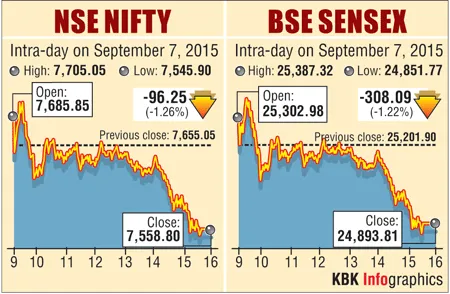
India’s benchmark equity indices ended lower on Friday after surrendering strong early gains amid renewed investor concerns over surging crude oil prices and sector-specific selling pressure. The BSE Sensex declined 160.73 points to close at 75,237.99, while the NSE Nifty slipped 46.10 points to settle at 23,643.50, breaking a two-session winning streak. Weakness in metal, oil and gas, and PSU banking stocks weighed heavily on sentiment despite a positive start to the trading session. Market participants remained cautious over inflationary risks linked to rising global energy prices, with investors increasingly reassessing the outlook for corporate margins, monetary policy, and near-term market stability.
Benchmark Indices End Lower After Volatile Session
BSE Sensex and Nifty 50 closed lower on Friday after a volatile trading session in which early optimism gave way to broad-based selling pressure across several key sectors.
The 30-share Sensex fell 160.73 points, or 0.21 percent, to settle at 75,237.99 after fluctuating sharply between gains and losses throughout the day. The index had initially surged nearly 470 points during morning trade before losing momentum as profit-booking intensified.
Meanwhile, the 50-share Nifty declined 46.10 points, or 0.19 percent, to close at 23,643.50, snapping its previous two-session rally.
The reversal in market direction reflected increasing investor caution amid rising global crude oil prices and concerns surrounding their broader economic implications.
Rising Crude Oil Prices Weigh on Investor Sentiment
One of the primary drivers behind Friday’s market weakness was the sharp increase in international crude oil prices, which reignited concerns over inflationary pressures and macroeconomic stability.
For India, which remains heavily dependent on crude oil imports, sustained increases in global energy prices can significantly impact inflation, fiscal balances, and corporate profitability.
Higher crude prices typically translate into elevated transportation and manufacturing costs, placing pressure on company margins across multiple sectors.
Market participants fear that persistent energy inflation could complicate the monetary policy outlook and potentially delay expectations of future interest rate easing.
The renewed volatility in energy markets therefore triggered a defensive approach among investors despite the market’s initially positive opening.
Metal, Oil & Gas and PSU Banks Lead Decline
Sector-specific selling pressure also contributed heavily to the market’s late-session weakness.
Metal stocks came under pressure amid concerns about global demand conditions and rising input costs, while oil and gas shares reacted negatively to uncertainty surrounding energy price fluctuations and refining margins.
Public sector banking stocks also witnessed selling activity as investors adopted a more cautious stance toward rate-sensitive sectors.
Among notable laggards were shares of Tata Steel and State Bank of India, which weighed on benchmark indices during the latter half of the trading session.
Analysts noted that the broad-based nature of the selling reflected a combination of profit-booking and defensive repositioning rather than panic-driven market behavior.
Early Optimism Fades Amid Global Uncertainty
Markets had initially opened on a strong note, supported by positive domestic sentiment and expectations of continued earnings resilience.
However, as the session progressed, global concerns surrounding energy markets and inflation risks began to overshadow early optimism.
Investors increasingly shifted focus toward external macroeconomic variables, particularly crude oil dynamics and their potential implications for emerging markets such as India.
The sharp reversal from early gains highlighted the fragile nature of current market sentiment, where even moderate global disruptions can trigger rapid shifts in investor positioning.
Traders also appeared reluctant to take aggressive directional bets ahead of further clarity on global commodity trends and central bank signals.
Inflation Concerns Re-Emerging in Market Narrative
The rise in crude oil prices has revived inflation-related concerns that had eased somewhat in recent months.
Economists warn that prolonged energy inflation could impact both consumer spending and corporate earnings growth if companies struggle to pass on higher input costs.
For policymakers, rising crude prices create additional complexity in balancing inflation control with economic growth support.
Market participants are therefore closely monitoring whether current energy price increases remain temporary or develop into a more sustained trend.
Should crude prices remain elevated, analysts believe sectors dependent on fuel-intensive operations may face increasing margin pressure in coming quarters.
This uncertainty contributed to Friday’s cautious trading environment.
Domestic Fundamentals Continue to Provide Support
Despite the day’s decline, analysts emphasized that broader domestic market fundamentals remain relatively stable.
India’s economy continues to benefit from resilient consumption trends, infrastructure spending, and improving corporate balance sheets, all of which continue to support medium-term equity market sentiment.
Recent earnings announcements across several sectors have also remained broadly constructive, helping offset some concerns surrounding external volatility.
Institutional investors therefore appear to be treating current market weakness more as a short-term adjustment rather than a structural deterioration in market conditions.
However, the extent of future volatility will likely depend heavily on the trajectory of global commodity prices and geopolitical developments influencing energy markets.
Investors Shift Toward Defensive Positioning
Friday’s trading pattern suggested a gradual shift toward defensive positioning among market participants.
In periods of heightened uncertainty, investors often reduce exposure to cyclical sectors such as metals and financials while increasing allocations toward defensive industries perceived as more resilient during inflationary environments.
The market’s inability to sustain early gains indicates that traders remain cautious about near-term risk exposure despite relatively strong domestic economic indicators.
Foreign investor flows, crude price movement, and central bank commentary are expected to remain key variables influencing market direction in the coming weeks.
Analysts also noted that volatility may persist as global investors continue recalibrating expectations surrounding inflation, interest rates, and economic growth.
Market Outlook Hinges on Global Commodity Stability
Looking ahead, market direction is likely to remain closely tied to developments in global commodity markets, particularly crude oil.
If energy prices stabilize, Indian equities could regain momentum supported by domestic growth resilience and corporate earnings strength.
However, sustained upward pressure on crude prices may continue weighing on investor confidence, particularly in sectors sensitive to input cost inflation and interest rate expectations.
For now, Friday’s decline underscores the growing influence of external macroeconomic factors on Indian financial markets, even as domestic fundamentals remain comparatively robust.
The session ultimately reflected a market balancing optimism around India’s growth trajectory against the uncertainty created by an increasingly volatile global economic environment.
Comments